Common Challenges in Choosing Between Supplier Audits and Product Inspections
Supplier audits and product inspections answer different questions. An audit reviews selected management systems, processes, and site evidence; a product inspection checks identified units or lots against defined acceptance criteria. Buyers should choose based on the risk and decision, and may need both at different stages.
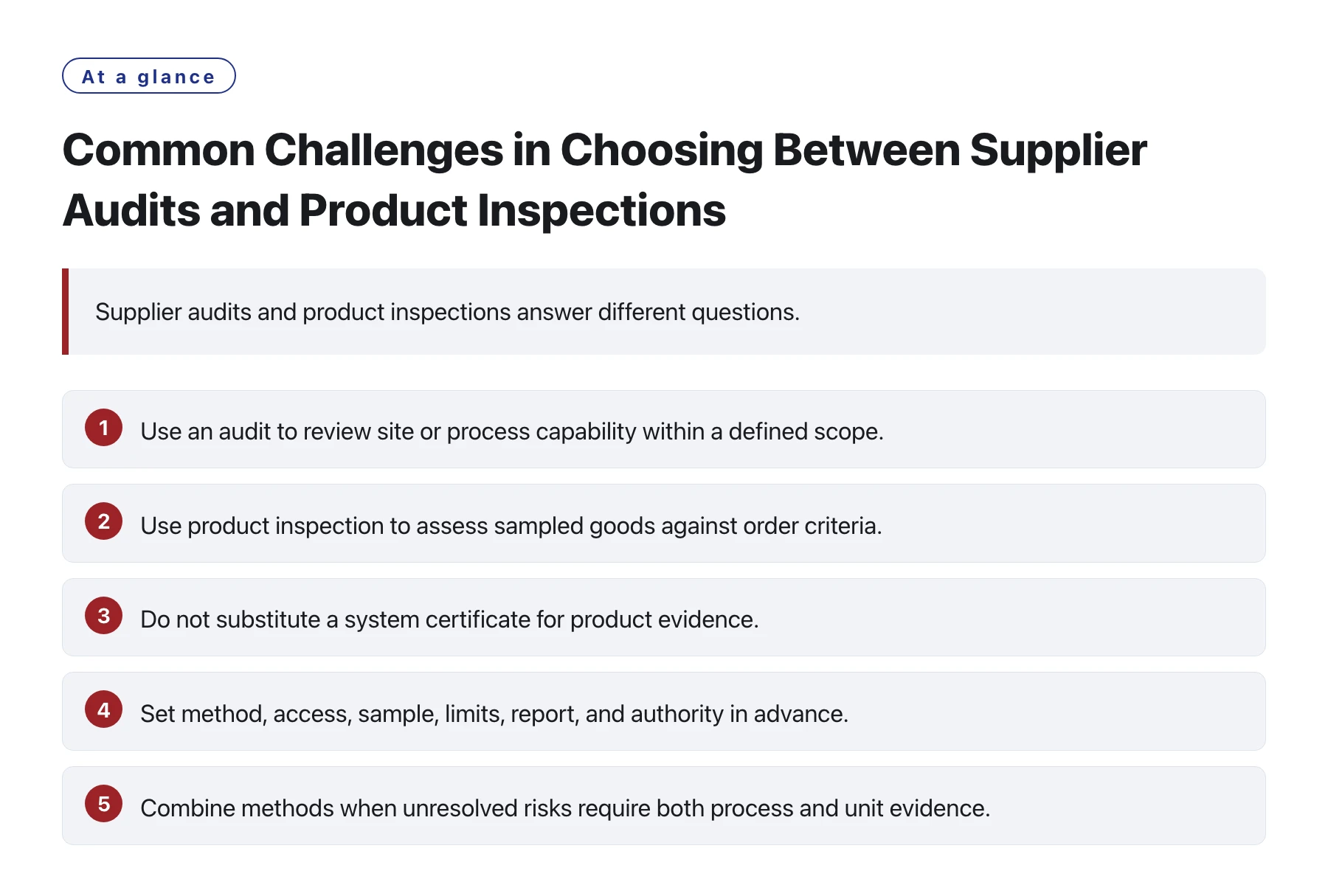
Key takeaways
- Use an audit to review site or process capability within a defined scope.
- Use product inspection to assess sampled goods against order criteria.
- Do not substitute a system certificate for product evidence.
- Set method, access, sample, limits, report, and authority in advance.
- Combine methods when unresolved risks require both process and unit evidence.
Audit and inspection plans are most useful when they support a named decision with evidence within a stated scope.
1. What does a supplier audit examine?
An audit can review site identity, process flow, competence, records, equipment controls, traceability, nonconformance handling, and subcontracting, depending on its scope. It samples evidence and reports what was observed or not verified.
ISO 9001:2026 specifies quality management system requirements. A certificate or audit of such a system does not itself establish that a particular shipment conforms to its purchase specification. [1]
Review audit frequency when the factory, process, site, or quality history changes. Increase attention when new risks emerge and reduce duplicated reviews when evidence already exists. Document the reason for the chosen method so teams can explain what was checked and what remains open.
2. What does a product inspection examine?
A product inspection evaluates identified samples or units against requirements such as dimensions, appearance, function, quantity, labels, packaging, or documents. Its usefulness depends on a clear specification, lot definition, method, sampling plan, and acceptance rule.
A final inspection takes place at a particular time and checks a stated scope. It may not reveal hidden process weaknesses, future production drift, or defects outside the sample.
3. Start with the decision and risk
Ask whether the buyer needs to qualify a site, verify a process, assess a current production lot, check packaging, or release a shipment. Consider product safety, failure impact, process complexity, past defects, supplier history, and order size.
Select audit criteria and product checks proportional to risk. A low-risk repeat order from a stable process may need different coverage from a new supplier making a complex or regulated product. Assign qualified owners to safety and market decisions.
The method should follow the decision. A buyer deciding whether a supplier is generally capable needs different evidence from a buyer deciding whether a finished lot is ready to ship. Write that decision at the top of the work request.
4. Compare method, timing, and evidence
An audit can occur before order placement or during production to review capability and controls. A product inspection can occur during production, before shipment, or on receipt to examine sampled units. Choose timing while there is still room to contain or correct findings.
Define access, records, sample selection, test equipment, report deadline, photos, and escalation. Remote review can improve access to records but has limits compared with on-site observation and physical measurement.
5. Avoid common substitutions
A quality certificate is not a product inspection. A product inspection is not a supplier audit. A successful factory visit does not approve a lot, and a passed sample does not establish all ongoing process controls. Keep conclusions within the method’s scope.
If the inspector finds a problem, the buyer needs a disposition and corrective action. Do not let the provider invent missing tolerances or regulatory requirements. Refer decisions to the authorized technical, quality, or compliance owner.
6. Define sampling and acceptance before inspection
For product checks, identify lot boundaries, sampling, classification, acceptance or rejection, reinspection, and how defects are recorded. If statistical sampling is used, specify the plan and contract basis. Critical characteristics may need other controls.
For audits, identify records and process samples to review, areas to visit, and interview roles. State what is excluded and how unavailable evidence will be reported.
7. Use findings to select follow-up
An audit finding about weak revision control may call for document correction and another record sample. A product defect may require containment, rework, sorting, replacement, or shipment hold. Define the owner, due date, and verification method.
Sometimes both methods are needed: an inspection finds repeated defects, then an audit examines the process that created them. Conversely, an audit may reveal a control gap that warrants targeted product testing.
8. Compare provider proposals
Ask providers to state purpose, criteria, method, access, sample, expertise, report, exclusions, conflict disclosures, and follow-up. Compare the evidence they will deliver rather than counting checklist pages or visit duration alone.
Confirm whether the provider advises, coordinates, or makes an authorized acceptance decision. The buyer should name who accepts supplier status, product conformity, and shipment release.
9. Build an inspection strategy, not a single checkbox
Document when audits, in-process checks, final inspection, laboratory tests, and receiving checks are required. Revisit the strategy after supplier, product, process, or risk changes. Track outcomes to refine future coverage.
Buyers comparing Shanghai JS Sourcing can define whether they need a site audit, product check, or both, and request a scope that clearly separates evidence and decisions.
Sources
Frequently asked questions
When should a buyer choose a supplier audit?
Choose an audit when the decision concerns site capability, process controls, records, subcontracting, or supplier-system risk.
When is product inspection more useful?
Use inspection when the buyer needs evidence about identified units or a lot against defined product and packaging criteria.
Can one method replace the other?
No. Audits and inspections examine different evidence and should be combined when the risk requires both.
Who decides whether findings are acceptable?
A buyer-designated technical, quality, or compliance authority should decide under the agreed criteria and authority limits.